Commercial Restaurant Chair Fabric Specs: Double Rubs, Martindale, TB 117-2013
What double rubs, Martindale cycles, cleaning codes and CAL TB 117-2013 mean for restaurant chair fabric and vinyl, and the numbers to ask for before you order.
Short answer
For restaurant chairs, ask for at least 30,000 double rubs (Wyzenbeek) or 40,000 Martindale cycles, the industry's common heavy-duty contract guideline, and more for high-turnover seats; contract vinyls often test at 100,000 double rubs or above. Check the cleaning code, colorfastness and seam performance too. For fire performance in the US, CAL TB 117-2013 is the most widely referenced smolder standard; confirm what your local fire official requires.
This guide explains each number on a fabric or vinyl spec sheet, which ones matter for restaurant seating, and how to specify upholstery so it survives service. It is written by Chair Foundry, a line by EASEN Commercial Furniture, where we review the cover specification on every upholstered chair we build.
What are double rubs?
Double rubs measure abrasion resistance using the Wyzenbeek method (ASTM D4157), the test most often quoted in the US. A machine rubs a cotton duck cloth or wire screen back and forth across the fabric under tension; one back-and-forth pass is one double rub. The test stops when the fabric shows noticeable wear or breaks, and the count is reported.
What is the Martindale test?
The Martindale method (ASTM D4966, ISO 12947-2) rubs the fabric in a figure-eight (Lissajous) pattern against a standard abradant and counts cycles to failure. It is the method most common in Europe and much of Asia, and it is often reported for fabrics made outside the US.
Double rubs and Martindale cycles cannot be converted directly. The tests use different motions and abradants. Compare a fabric against guidelines for the method it was tested by.
How many double rubs does a restaurant chair need?
The Association for Contract Textiles (ACT) publishes voluntary performance guidelines for contract upholstery. Its abrasion guidelines are widely used as a baseline:
| Use level (ACT guideline) | Wyzenbeek (double rubs) | Martindale (cycles) |
|---|---|---|
| General contract upholstery | 15,000 | 20,000 |
| Heavy-duty upholstery | 30,000 | 40,000 |
For restaurant seating, treat heavy duty as the floor, not the target. Many specifiers ask for 50,000 double rubs or more for dining chairs in busy rooms, and contract vinyls commonly test at 100,000 or more. Higher numbers above a certain point stop telling you much on their own. Construction, fiber, backing and finish matter just as much.
| Seating situation | Suggested cover | Practical abrasion target |
|---|---|---|
| Family dining, high turnover, frequent wipe-downs | Contract vinyl | 100,000+ double rubs |
| Casual dining, moderate turnover | Contract woven or vinyl | 50,000+ double rubs |
| Fine dining, hotel restaurants | Contract woven, leather | 30,000-50,000+ double rubs |
| Back panels, outer backs | Fabric or vinyl | Heavy-duty minimum |
| Bar stools | Vinyl or tight weave | 50,000+ double rubs |
What else should be on the fabric spec sheet?
Abrasion is only one line. For restaurant upholstery, also check these ACT-referenced properties:
- Colorfastness to light (AATCC 16). Seats near windows fade; ask for results suited to your light exposure.
- Colorfastness to crocking (AATCC 8). Measures dye rubbing off, wet and dry. Dark fabrics that crock can stain light clothing.
- Pilling (ASTM D3511 or D4970). Bobbles on the surface make chairs look old quickly.
- Seam slippage and breaking strength. Tightly upholstered chairs put seams under constant tension; weak seams pull open.
- Physical properties of vinyl. Ask for hydrolysis or aging resistance on polyurethane-coated fabrics; poorly formulated PU can crack and peel.
What do upholstery cleaning codes mean?
Most US fabrics carry a cleaning code. These are the conventional meanings; always follow the mill's own instructions:
| Code | Meaning | Restaurant suitability |
|---|---|---|
| W | Water-based cleaners | Good |
| S | Solvent-based cleaners only | Poor for daily cleaning |
| W/S or SW | Water- or solvent-based | Good |
| X | Vacuum or brush only | Avoid for seats |
Contract vinyls are usually cleaned with mild soap and water, and many are formulated to tolerate diluted bleach or common disinfectants; check the mill's cleaning guide for approved products and ratios. Repeated alcohol or harsh solvents can dull or crack some coatings.
What is CAL TB 117-2013?
California Technical Bulletin 117-2013 is a smolder-resistance standard for upholstered furniture. It tests cover fabrics, barrier materials and filling materials for resistance to ignition by a smoldering cigarette. It replaced the earlier open-flame TB 117 test and is now the most widely referenced flammability label on upholstered seating sold in the US.
What it is and is not:
- It addresses smoldering ignition, not open flame.
- It is a California requirement for upholstered furniture sold there, but specifiers across the US often reference it.
- Public occupancies such as restaurants may have additional or different requirements under the fire code adopted locally, and some fire officials refer to tests such as NFPA 260 or ASTM E1353 for cigarette ignition resistance of components. Larger or unsprinklered venues may face stricter rules.
Because requirements vary by jurisdiction and occupancy, check with your local fire marshal or code official, then specify to that. Chair Foundry specifies fire-retardant foams and contract-grade fabrics to the destination market's rules on request, for example builds intended to meet TB 117-2013, and supplies test reports for the specific item where available.
Vinyl, fabric or leather: which is best for restaurant chairs?
| Factor | Contract vinyl | Woven contract fabric | Leather |
|---|---|---|---|
| Cleaning | Easiest; wipe down | Water-based cleaners; spills soak in faster | Damp cloth; needs conditioning |
| Abrasion | Very high | Varies widely; check rating | Durable; scuffs and patinas |
| Comfort | Cooler in winter, warmer in summer | Breathable, warm | Breathable, ages well |
| Look | Leather-look to bold colors | Widest range of textures | Premium |
| Best for | Family dining, diners, high turnover | Fine dining, hotels | Steakhouses, lounges |
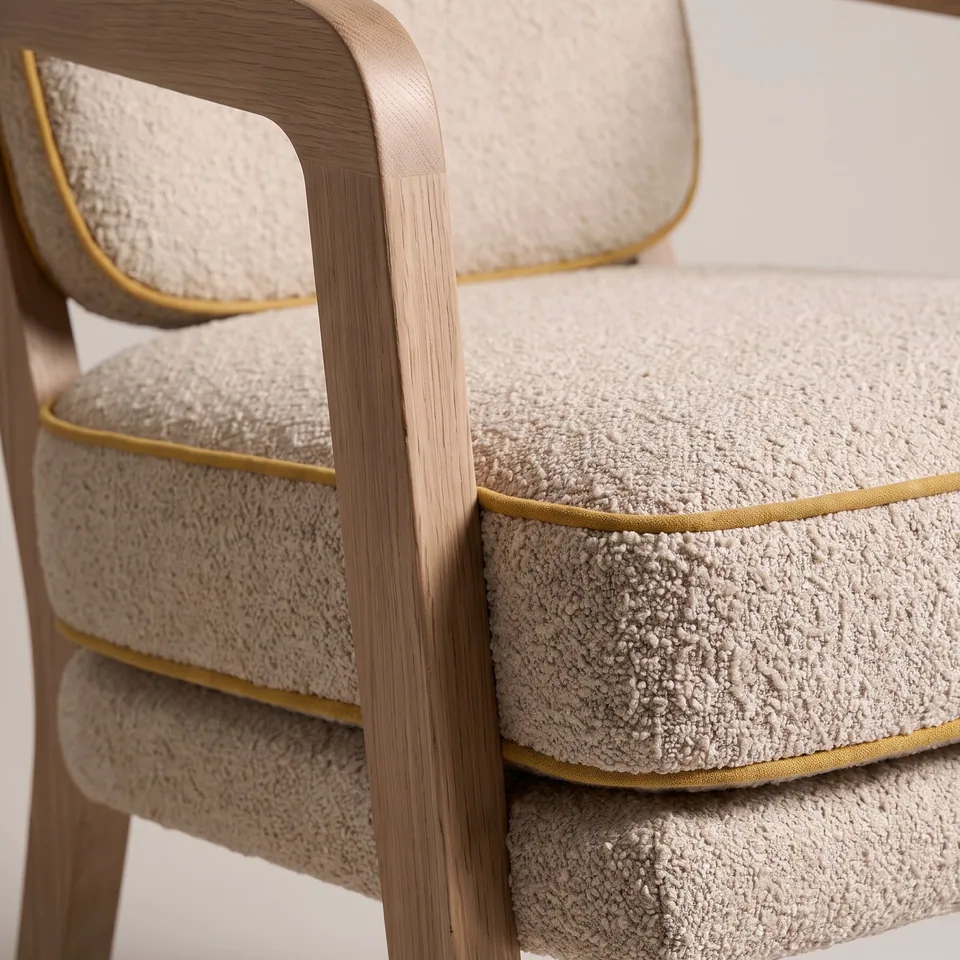
Many good restaurant chairs combine materials: fabric on the inside back for warmth, vinyl on the seat and outer back for wear. The Quinn Two-Tone Armchair and the Delaney Curve-Back Side Chair are built to take two covers. Browse more in our upholstered dining chairs collection.
Should I use my own fabric (COM)?
You can. Customer's own material (COM) and customer's own leather (COL) are standard in contract seating. To avoid problems:
- Send the full spec sheet, not just the color name: abrasion, cleaning code, backing, width, repeat.
- Ask us for yardage per chair before you order the fabric. Pattern repeats and railroading affect usage.
- Check the backing. Loosely woven or very stretchy fabrics may need a backing applied before they can be upholstered tightly.
- Order 5-10% extra for cutting allowances and future repairs from the same dye lot.
- Approve a sample chair in the actual COM before production if the fabric is unusual.
Checklist: upholstery spec for a restaurant chair
- Abrasion: method stated (Wyzenbeek or Martindale) and meets your target.
- Cleaning code: W or W/S, or a vinyl with a published cleaning guide.
- Colorfastness to light and crocking acceptable.
- Pilling and seam performance acceptable.
- Fire performance to your local requirement, with reports where available.
- Foam: high-resilience; fire-retardant where required.
- Seat removable from below for recovering.
- Extra yardage ordered from the same lot.
Common mistakes
- Comparing double rubs to Martindale cycles. They are different tests.
- Specifying a residential fabric because it looks the same. It may have a fraction of the abrasion rating.
- Using X-code fabrics on seats. They cannot be wet-cleaned.
- Tufting or buttons on seats. They trap crumbs and strain the cover.
- Assuming TB 117-2013 covers everything. Check local requirements for public occupancies.
- Running out of COM. A second dye lot rarely matches perfectly.
FAQ
Is 50,000 double rubs good for a restaurant chair?
Yes. It is well above the ACT heavy-duty guideline of 30,000 and a sensible target for most dining chairs. For very high-turnover seating, contract vinyls at 100,000+ are common.
What does TB 117-2013 compliant mean?
It means the cover, barrier and filling materials passed California's smolder-resistance tests under Technical Bulletin 117-2013. It addresses cigarette ignition, not open flame.
Can I convert Martindale cycles to double rubs?
No. The tests use different motions and abradants, so there is no reliable conversion. Compare each against guidelines for its own method.
Which is easier to clean, vinyl or fabric?
Contract vinyl is generally easier: most spills wipe off and many vinyls tolerate common disinfectants. Check the mill's cleaning guide before using bleach or strong chemicals.
Can Chair Foundry upholster chairs in my own fabric?
Yes. We accept COM and COL, confirm yardage per chair, and tell you before production if a fabric's specification looks unsuitable for restaurant use.
Tell us your seat count, table sizes and the look you want. We reply with recommended models, seat heights and a quote, usually with draft drawings attached.
Request a quote